I’ve been around tennis circles for 30 years now. As a developing junior, college athlete and for over 15 years now, a performance coach to hundreds of players.
I’m sharing this backdrop because I’ve seen it all. More importantly, I’ve tested every training modality on myself, studied the mechanics and learned from some of the best coaches in the world.
From an experienced coaching and playing perspective, I want to address a persistent trend in tennis training: agility ladders and ‘fast feet’ drills. I’ll break down why most of it is just eye candy and what players actually need to train, in order to improve their movement on-court.
What Most People Do
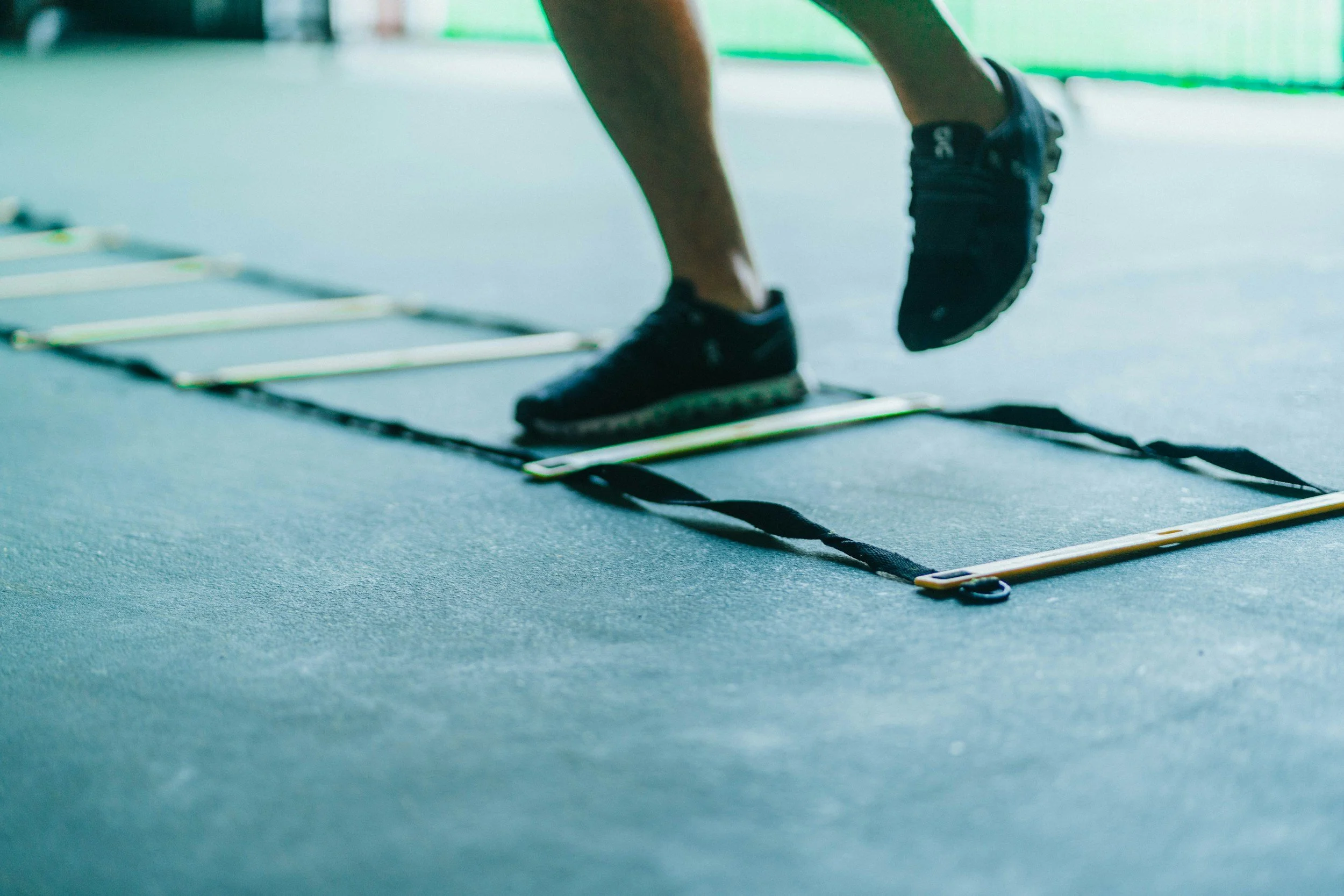
Walk by almost any tennis court or academy setting, and you’ll still see players running through agility ladders or doing rapid toe-tapping drills over lines.
I know that some will argue that ladders are just a warm-up tool. That it acts as an activation drill to get players going.
While I have no objection to that (even though I believe there are better ways to use our time in the warm-up), some will still argue that these drills will enhance a player’s ‘footwork’ on the tennis court.
The Science of Tennis Agility
These footwork drills – where a player jumps very quickly back & forth over the service line or performs some sort of in & out ladder drill – don’t hold up when we’re looking at what really makes up movement, and more specifically – agility – in tennis.
I told you, I’ve “done it all”… but I no longer do this!
Agility is made up of 2 primary components:
Perceptual-Cognitive Factors - This is your brain’s processing ability to an external stimuli. On the tennis court, it’s a player’s ability to scan the court, recognize the pattern / situation, make a tactical decision and react to the incoming ball.
Change-of-Direction (COD) Factors - This deals more with the physical side of the equation and includes linear speed, concentric & eccentric force generating abilities, reactive strength and body positioning.
In tennis, the perceptual side of the equation gets more attention. And rightfully so. If you’re late reading the ball or unsure of what tactical decision you need to make, no amount of speed will save you.
While perceptual factors can be primed away from tennis – using reaction balls, auditory or visual signals etc – they are best developed during task-specific live-ball tennis practice.
Where players consistently lag behind, however, is in pure COD training.
The Real Tennis On-Court Movement Sequence
Every change-of-direction instance on the tennis court follows a predictable pattern:
Response / Acceleration: The player responds to the incoming ball and accelerates towards it.
Deceleration / Braking: As they approach the ball, they decelerate / brake rapidly, aiming to establish a solid foot position - called the ‘plant phase’.
Transition / Strike: Maintaining static or dynamic balance while striking the ball.
Recovery / Re-acceleration: Finally, the player pushes aggressively against the ground into a recovery position for the next shot.
These phases require distinct force dynamics, muscle actions, and joint stackings.
Why Footwork Ladders Fail to Transfer
No Momentum to Manage
Ladders don’t actually train any of these phases – at least not to any significant extent to which they’d actually improve the COD factors we mentioned above.
The big reason - when we’re moving on court, we’re constantly dealing with momentum. In other words, we’re trying to maintain momentum or we’re trying to redirect momentum efficiently and into a different direction this (includes our center of mass).
Those requirements are almost non-existent with ladders.
Zero High-Force Generation
Generating force is a key underpinning COD quality that needs to be developed to a high level. If we look at the 3 phases from above, we can associate them broadly with muscle actions.
Acceleration requires concentric strength. Deceleration requires eccentric strength and planting/transitioning requires isometric strength. Ladders involve minimal force output into the ground, offering virtually no neuromuscular stimulus.
Toe-Tapping vs Full-Foot Force Production
Ladders encourage players to dance exclusively on their toes. If you study elite movers—whether it’s Roger Federer or Michael Jordan — they achieve high force production by using a full-foot or near-full-foot contact.
This full tripod contact allows the lower-limb joints (ankle, knee, hip) to stack efficiently and drive maximum force into the court surface.
They’re Not Actually ‘Agility’ Drills
Recall that agility is a combination of perceptual qualities (cognitive) and COD abilities (physical). What do you see when most are performing ‘ladder’ of ‘footwork’ drills? Their eyes are staring straight down into the ground.
That immediately negates ‘the response to an external stimuli’ — which is by definition — the perceptual-cognitive side of agility. That alone tells us that there’s no visual scanning, anticipation, decision-making or pattern recognition being targeted.
Ladders are only physical drills. But in terms of developing COD, as was mentioned, they don’t do a good job of that either.
What Tennis Players Should Do Instead
Consistent Acceleration / Sprint Training
If you’re a serious player (or coach), can I ask you how many times a week your players are sprinting maximally? That’s not a typo, I’m talking about weekly sprint training. Not monthly. Not in one particular block of the year.
Every week, all year round, whether you’re in-season or not, tennis players should be sprinting.
Most of that sprint work can happen on the tennis court before a practice session, with distances ranging from 5m to 30m – the sweet spot being about 10-20m.
If you’re in a training block, you can probably do more sprint volume. If you’re in-season, a few 10-15m sprints before practice is recommended for maintenance. Either way, you’re constantly refining:
The skill associated with propelling your body from a static position.
Your ability to generate horizontal and vertical ground reaction forces.
Adaptations associated with this form of training – which are largely neural.
A sprint start variation that accentuates acceleration shapes.
Plyometric & Weight Training
When you’re changing direction, you’re actually generating high ground reaction forces (GRF) in both the vertical and horizontal directions.
Plyometrics: Plyos are exceptional here because you’re dealing with high forces that more naturally take into account both vertical and horizontal forces. You’re also learning to apply force into the ground in a dynamic manner, often aiming to minimize ground contact times in the process.
Weight Training: I’m not just talking about Bulgarian split-squats and side lunges. To develop concentric and eccentric strengths, exercises that demand aggressive pushing actions against the ground are the cornerstone.
That usually looks like a squat variation when trying to overcome an external force. Olympic lifting variations can improve vertical propulsive abilities but also train eccentric rate of force development during the catching phase.
A multidirectional plyometric.
Oly lift that targets concentric and eccentric force capabilities.
Dedicated COD and Reactive Agility Training
While many underpinning qualities contribute to improved COD training, the principle of specificity tells us that ‘doing the thing’ will improve your ability to ‘do the thing’.
In other words, COD training itself is non-negotiable. This includes drills that target the above mentioned phases – acceleration, deceleration and transition – all in one.
These are closed-chain drills where the movements and changes of direction are pre-planned. In other words, predictable.
But what about ‘agility’ training? Recall that agility includes both perception (your cognitive abilities) and COD (your physical abilities).
Many of our COD drills can easily become agility drills. You could toss a series of balls in the air (one after the other) and ask the athlete to track them down. They’re reacting to where you’ve thrown those balls and performing COD actions.
This is a COD drill.
This is an agility drill.
Tennis Is Still The Best Form of Agility Training
Having said all of that, in my coaching framework, most of the ‘agility training’ happens on the tennis court with a live ball in play.
While enhancing the physical qualities that make up COD happen off the court via COD drills, sprinting, plyometrics and weight training, nothing can improve your perception skills like the task itself.
Should You Ever Use Footwork Ladders
If you’re adamant about using ladders, use them during warm-ups. Just don’t rely on them to build on-court movement speed.
That requires a steady dose of tennis perception drilling/cueing and physical training that includes the qualities that were outlined in this post.