
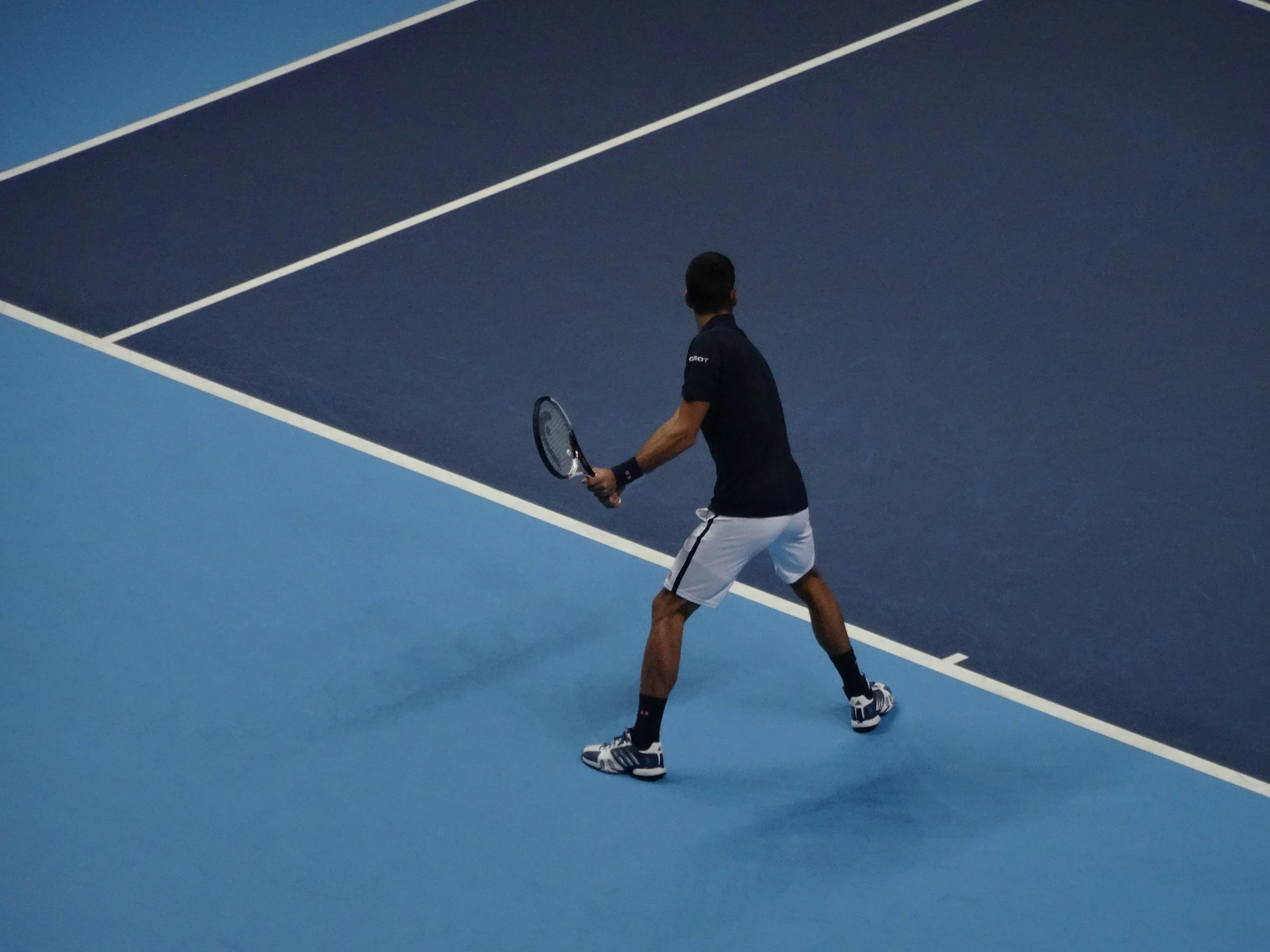
You don’t have to be the fastest player on the court to ‘feel fast’.
Previously, I’ve argued that Djokovic – while a terrific athlete – isn’t the fastest, most explosive or powerful player on tour.
But yet he’s seemingly always on top of the ball.
Personally, I’m not quite the player I once was, but at 40 years old, I’m still practicing with college and pro level players who are half my age.
But there’s an underlying reason I’m able to do that - beyond being fit and athletic for my stage of life.
It’s that I consistently practice things that make me look (and feel) faster than I am.
I’m no Djokovic - but I’ve stolen some of his secrets and applied them to my own game, along with countless others.
Below, I’ll share some of those secrets.
4 Ways to Train Your ‘Tennis Eyes’
1 - Reading the ‘Depth’ of the Ball Better
Many coaches preach the importance of lateral movement in tennis. While I don’t disagree on its importance, I’ll say this: depth perception isn’t spoken about enough - and definitely not trained to the highest of standard.
What I mean by depth perception is a player’s ability to see whether the ball is short or deep, and use their eyes to pick up that ball flight feature early.
The deeper balls typically have more spin and shape. And will push players back. Or at least should push a player back (so they don’t hit the ball above their head). Better players might be able to hit some of these on the rise — but tactics will influence this too.
The shorter ones aren’t necessarily short / approach shots (although they could be); for the most part, they are balls where a player should move forward on (instead of letting them drop and making contact at ankle height).
Many players struggle and end up doing 2 things poorly here:
They don’t actually judge the depth of the ball well enough and/or early enough. You’ll see it all the time, the ball is either jumping above their shoulders (on the deep ones) or they’re just not getting to the short balls. Worse yet, they let the ball bounce twice during a simple rally exchange.
If they do judge the ball well, they don’t track it down. This is a result of either initiating their first step movement late or they just don’t quite get into the best position. Another possibility is that they can’t judge the ball, track it AND prep their stroke, all in sequence. This inevitably disrupts timing.
Drill: Up or Back
The fix is simple (but as it goes, not easy). On every single ball, a player calls out ‘UP’ when the ball is short / will force them to move forward and ‘BACK’ when the ball is deep / will force them to move further back.
The whole idea here is that this is done early enough so that you’ll be in a good position to strike the ball in front and at the ideal height off the ground.
Because here’s the thing, it’s really difficult to express good technique / mechanics if you’re reaching for the ball or hitting it while it’s above your head.
This is a drill that’s great to practice every time you step on the court. It doesn’t require any basket feeding and your partner doesn’t even have to know what you’re working on. Just call out (in your head or out loud), ‘UP’ or ‘BACK’ on every single ball. Even if it’s just 1 step or ½ a step forward or backward, make a decision along with the footwork adjustment.
2 - Stroke Recognition
This sounds simple enough but you’d be surprised how late many club tennis players are when aiming to recognize whether they must hit a forehand or a backhand.
Because if you’re late recognizing the correct stroke, you’ll be late with your unit turn, your setup and more often than not, your timing will be completely off.
Similar to what we discussed with depth perception above, it’s important to be early given that tennis is a very ‘time-oriented’ sport. You just don’t have that much of it and the more milliseconds you can save, the better!
Drill: Fore or Back
This drill is straightforward – call out ‘FORE’ if you’re going to hit a forehand or ‘BACK’ when you’re going to hit a backhand.
The key is, do it as soon as you know which stroke you’ll be hitting. The aim is to try to recognize it as soon as it leaves your opponent’s strings! Ideally, you’re able to pick up the direction of the ball before it crosses the net.
When you do, you begin your unit turn.
You don’t have to prep by immediately bringing the racquet back into the cocked position (ala Serena Williams), but you do have to ‘begin’ your stroke preparation.
When I prescribe this drill to players (even high level players), they’re shocked at how much time they seem to gain and how well it improves their stroke timing in general.
3 - Learn to Adjust to the Speed of the Ball
The speed of the ball should play a factor in how you prepare. Truth is, most players don’t adjust their prep at all – they prep the exact same way whether the ball is hit hard or soft, whether they’re on hard or clay or whether they’re playing indoors vs outdoors.
But remember, the whole point of tennis is to have adequate timing. In other words, to meet the ball in the most ideal spot for the shot at hand.
If you’re playing on a fast court and you’re constantly meeting the ball late / behind you, that’s clearly not the best timing to have for that particular situation.
I know sometimes it’s bound to happen – and you’ll hit that lasso Rafa forehand (I have no problem with that in certain situations) – but it shouldn’t be the goal on every ball.
Here’s the fix.
Drill: ‘Short’ Prep
This cue is surprisingly revealing. Here it is – every time the ball is coming at you faster or deeper etc. - in other words, you feel like you’re going to be rushed, call out the word ‘short’.
‘Short’ can mean different things for different players. But most of the time, your stroke should feel 15-25% shorter (in terms of the prep), compared to normal.
On all other shots, you’ll just use your normal stroke prep.
Again, any time the oncoming ball feels like it’ll disrupt your timing, call out ‘short’ as early as possible and adjust accordingly.
The aim is that it’ll allow you to meet the ball in front, with a solid strike and correct timing, no matter what type of ball you receive.
4 - Hit Cleaner Strikes Repeatedly
We’ve now talked about judging the ball better, recognizing the stroke sooner and adjusting the prep based on ball quality / speed.
All of these drills / cues are designed to get players hitting with better timing.
But a key component of timing is strike quality. You might now be in a better position, ready to blast a forehand but if you mis-hit the ball (I’m not even talking about framing it, just not hitting it ‘centered’), all that work won’t matter. The drill below, solves this issue.
Drill: Watch the ‘Seams’ of the Ball
Me, focusing on the ‘seams’ and clean strking.
This cue was stolen directly from one of my favorite books of all-time, ‘The Inner Game of Tennis’ by Tim Gallowey.
It’s really simple, instead of just ‘watching the ball’, you try to watch the white ‘seams’ of the ball. The aim is to start picking up the seams as early as you can (there’s that timing element again) and focusing in on them all the way into impact.
While you won’t actually see the ball make contact with your strings, the intention to do so is what really matters here.
If you pair that with ‘paying attention to the sound of the ball’ thumping your strings, you’ll instantly feel the difference between hitting the ball truly ‘pure’ and missing the center.
You’ll also notice the quality of your shot improve drastically.
Takeaway
There you have it. Four trainable qualities that players either aren’t training enough, or not training at all! But these 4 drills are easy to implement into any session (no basket feeding required) and you’ll almost immediately feel a difference in your movement, prep, timing - and ball quality.
When I’m playing myself, I not only use these for improvement purposes but to also get my eyes focused on the right things (and my mind away from wandering).
In any case, I highly recommend you implement these into your sessions.